
CHIA RESEARCH SHOWS DISPARITIES IN RATES OF UNMET HEALTH-RELATED SOCIAL NEEDS BY RACE AND ETHNICITY
DATE: July 31, 2025
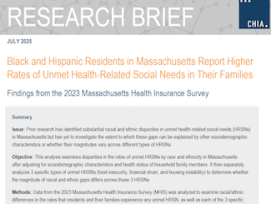
CHIA has published a new research brief examining disparities in the rates of unmet health-related social needs (HRSNs) by race/ethnicity in Massachusetts. Findings show that compared with White residents, Black and Hispanic residents experienced any unmet HRSN, such as food insecurity or housing instability, at significantly higher rates even after adjusting for other sociodemographic factors.
The brief, Black and Hispanic Residents in Massachusetts Report Higher Rates of Unmet Health-Related Social Needs in Their Families, utilizes data from the 2023 Massachusetts Health Insurance Survey (MHIS).
Racial and ethnic disparities in the rates of unmet HRSNs contribute to inequities in health care access, utilization, and affordability for Massachusetts residents. These findings can inform targeted policy interventions by prioritizing the communities experiencing the highest rates of unmet HRSNs and addressing specific HRSNs to improve health outcomes in the Commonwealth.
Key Findings
- Overall, 39.1 percent of Massachusetts residents had any unmet HRSN in the past 12 months. Food insecurity was the most common, followed by financial strain and housing instability.
- Black and Hispanic residents were more than 2 times as likely to experience any unmet HRSN compared with White residents.
- Black and Hispanic residents were 3 times as likely to experience food insecurity as White residents; residents who identified as multiracial or of other races experienced food insecurity about twice as often as White residents.
- Black and Hispanic residents reported financial strain at twice the rate of White residents.
- Compared with White residents, Black and Hispanic residents were nearly 3 times as likely to experience housing instability.
This brief is part of a collection of reports focused on health care equity in the Commonwealth. It seeks to fill the data gap in understanding the factors associated with unmet HRSNs, particularly for historically underserved populations.
This report aims to inform policies that address key social and economic factors outside of the health care system, with the ultimate goal of reducing acute care utilization and improving health outcomes.